-
CORE FRAMEWORK
FEATURED COMPONENTS
-
RESOURCES
-
LEARN ZK
RESOURCES


Arvato Systems Case Study
As global next generation IT systems integrator Arvato Systems focuses on “Digital Transformation Solutions”.
“ZK is easy to learn, and I like the possibility to create custom components, creating a hierarchy of reusable elements.”
About Arvato Systems
Arvato Systems uses the technology talent and expertise of over 3,000 people at more than 25 sites throughout the world. Being a part of the Arvato network and belonging to Bertelsmann, Arvato Systems has the unique capability to create entire value chains. The Arvato Systems team creates integrated, future-proof business infrastructures that help make clients more agile and competitive, and enable them to deliver new standards of service to their customers. Arvato System creates streamlined digital processes that support innovative business models. Moreover, Arvato Systems provides operation and support services.
Extensive Process Expertise in the Retail Environment
eCommerce begins with in-depth knowledge of markets and sales channels. Arvato Systems is a powerful partner with extensive expertise in brick-and-mortar and online retail processes gained from the Arvato Group's many years of experience in service-providing operations and consumer transactions.
ZK x aroma®
Arvato Systems, besides other options, provides the aroma® order management system as a Software-as-a-Service solution. aroma® provides a flexible order processing solution, using a BPMN 2.0 workflow engine to orchestrate the order processing steps.
aroma® offers a comprehensive web based UI which is used by the customer service teams as their key platform. aroma® provides a complete view on a customer's order history and payment status. Via aroma®, support cases such as cancellations, parcel redeliveries or return processing can be performed.
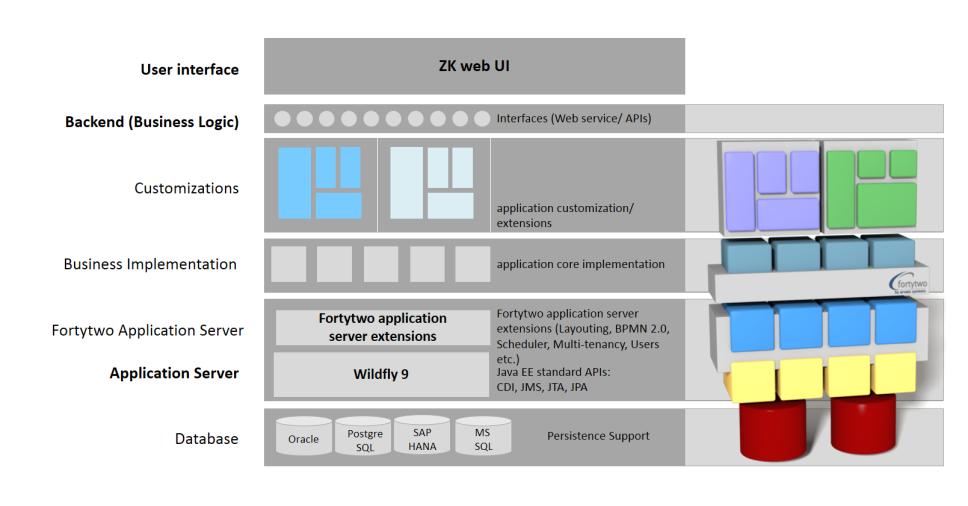
aroma® has been successfully used for more than 10 years now, based on Spring/ Hibernate, with a GWT UI. In 2012, the system was modularized and modernized, switching to a Java EE 6 software stack with the ZK 6 UI. Since then, the product is continuously kept up to date with currently technology, and currently it is based on Java EE 7 (using the Wildfly 9 application server) and ZK 8.
Architecture
aroma® has been implemented as a service oriented architecture. All database access is performed via web services, which take and provide data transfer objects (DTOs), decoupling the APIs from the persistence layer. The backend used the JPA 2.1 API to access the database. Currently, Hibernate (as part of the Wildfly application server) is used for persistence. The web service APIs are described via an Xtend based DSL, Bonaparte. The user interface accesses the backend only via the defined web services, which offers very good testability of the backend. The UI is built as a single page application, using the ZK borderlayout as the main element. This allows the users to minimize or adjust the size of the tile or menu areas as required.
“The best aspects of ZK are:”
- Intuitive approach, ease of learning
- Modularity
- MVVM architecture
- Separation of logic and layout
The Challenge
The main challenge was the implementation of the extensibility, where all business objects can be enhanced in customizations without affecting the core product.
Why ZK
GWT was used before switching to ZK, the reason for change is because there was a significant amount of boilerplate code which had to be written while ZK allowed readable source code in shorter period of time. Moreover, ZK allowed Arvato Systems to code UIs without Javascript, reducing the number of languages in their project. The availability of MVVM architectural pattern allowed a better separation of UI design and program logic. In addition, the model to express user experience in form of an XML (zul) file helped with the key challenge, allowed easy customization in the system.
The Best of ZK
“The best aspects of ZK are: intuitive approach, ease of learning; modularity; MVVM architecture; separation of logic and layout.” Dr. Michael Bischoff, Director Product Development at Arvato Systems
The Result
Arvato Systems had created a set of base components and achieved a very modular UI, which allows easy plug in additional screens. By standardizing the classes of screens (e.g. configuration screens), additional screens can be added with minimal effort. The majority of the parameters is provided by the backend, such that only very little UI code is required. One of the benefits of the application is that they can interactively customize the result sets to their personal preferences. The aroma® UI offers about 100 screens and is available in more than 10 languages. In the future, Arvato Systems hopes that some screens can be purely configuration based.