-
CORE FRAMEWORK
FEATURED COMPONENTS
-
RESOURCES
-
LEARN ZK
RESOURCES


Steria Case Study
Groupe Steria SCA (Steria) is a multinational Information Technology Services Company headquartered in Issy-les-Moulineaux, France. It delivers IT enabled business services, focusing on key vertical market sectors: public services, finance, telecommunications, utilities and transport. The company provides consulting services for its clients' core business processes, and also develops and operates their information systems.
“Learning period is short and the time necessary for the development of interfaces is nearly always respected.”
About Steria
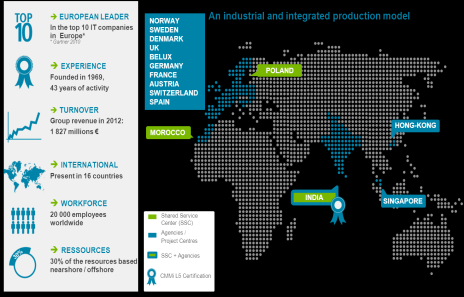
Headquartered in Issy-les-Moulineaux, France, Steria is a multinational information technology services company that delivers services using new technologies, which assists various administrations and companies in improving their efficiency and profit. Steria works with all sectors, focusing primarily on the public, finance, telecommunications, energy etc., and specializing in large customers and multi-million euro programs. Examples of the flagship customers are EDF, GDF, Pôle emploi, Choregie, ministries. Steria has 20,000 employees across 16 countries and continues to be a valuable leader of the systems, services and processes that are indispensable in the day-to-day life of millions of people.
ZK X AMR
Project AMR, Automated Meter Reading, involves the organization of the replacement of all French gas meters with meters that communicate automatically with the central information system. This project is included in an ecological European law to reduce the number of technicians on the roads by automatizing the meter reading. New concentrators need to be deployed to communicate with the meters by radio and then with the central system.
The applications developed in the current project AMR with GrDF (Gaz réseau Distribution France) are to be used to organize the deployment of 11 million gas meters. These applications will be used by up to 2000 users. The project began in December 2012 and will be finished in the summer of 2015 as one of the flagship projects of GrDF.
Three applications were developed in the first part of the project:
- Application for the administration of the information system
- Application for the organization and the follow-up activities
- Application for the definition of the buildings to be used for the installation of the concentrators which communicates by radio with the gas meters. These applications use a mixture of ZK and OpenLayers for cartographic components.
The first application concerning administration is used by fewer than ten users and essentially contains basic data entry screens.
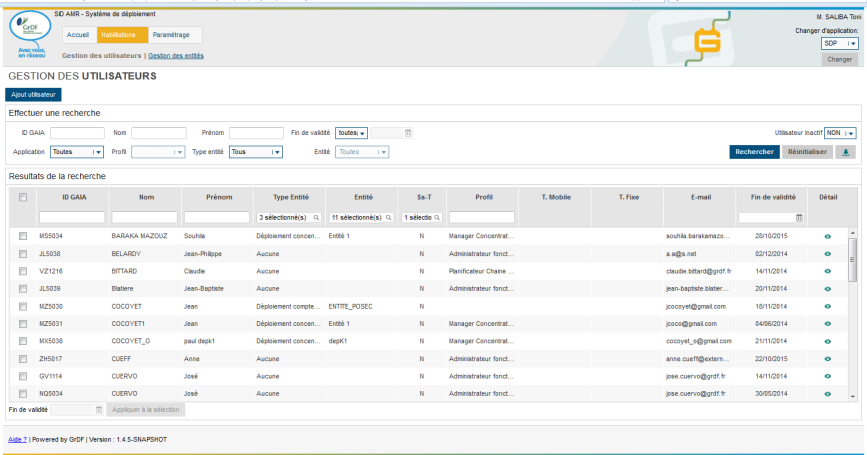
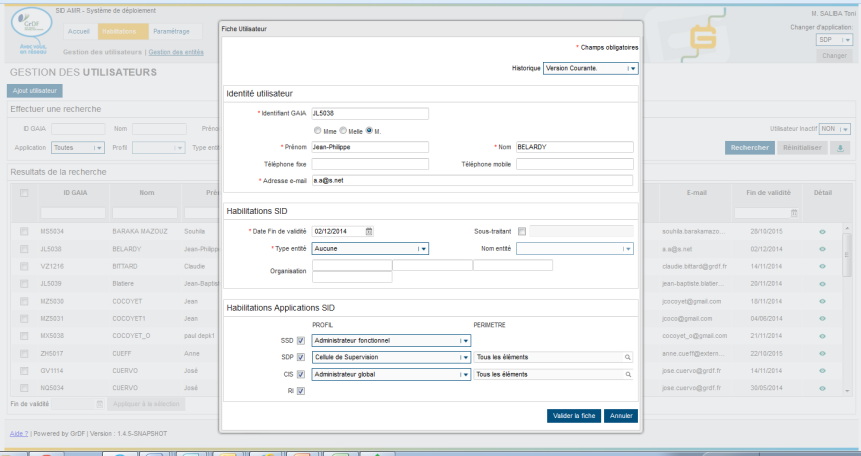
Creation of a new user:
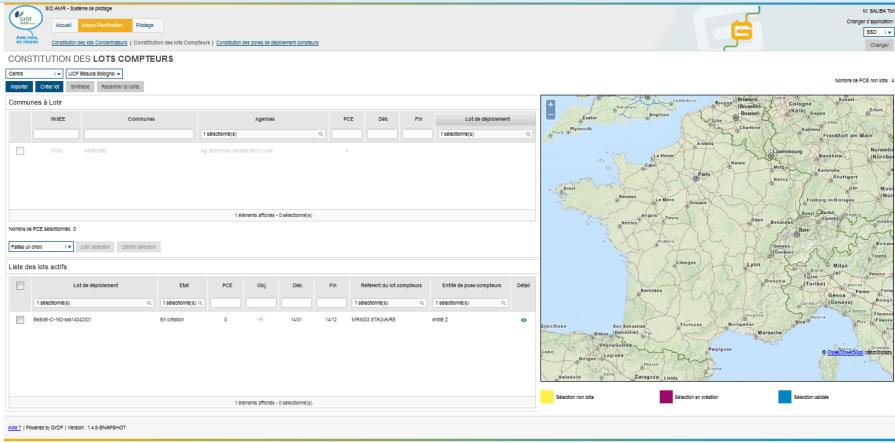
The second application used for the organisation and follow-up activities involves a mix of data entry components and cartographic components. This application has to support up to fifty concurrent users, as well as the creation of sets of concentrators to be deployed through the cartographies.
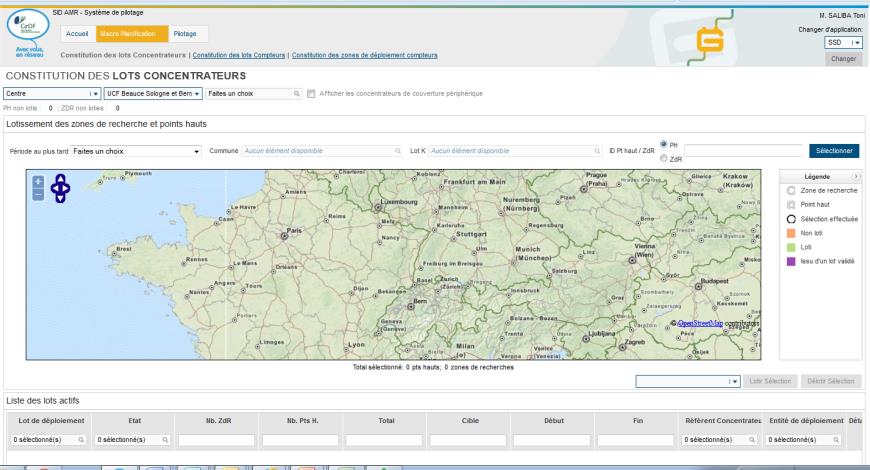
Creation of sets of meters to be deployed:
The third application uses the same components to organise the positioning and leasing conditions of the buildings for the concentrators.
“Thanks to the speed in which interfaces can be developed, I even thought of using ZK to produce the models used for the specifications!”
Architecture
ZK, Spring, MyBatis, JEE, Oracle 11 and Spring Batch. For the first part of the project, the applications were used in an intranet and for the second part of the project there will also be extranet use.
The Challenge
The main challenge lies in keeping the performances acceptable (< 2 seconds per screen) with a volume of 11 million meters. Very functionally rich screens have also been a major concentration of the project; each screen has several table components, panels, open layers maps, listboxes, comboboxes, and input elements. We have also implemented asynchronous treatments piloted by spring and needing to differentiate the timeout for IHM and the asynchronous treatments.
Why ZK
Several frameworks were considered during evaluation, including Smart GWT, JQuery etc. With Smart GWT, it is difficult to control the render (black box) and the specific development is hard as it uses JavaScript. Development is easier in ZK (no JavaScript, no Ajax, components are present on client and on server, event) and we are able to successfully control the render. ExtJS, Vaadin were too immature at the time.
The factors evaluated were:
- level of difficulty in understanding the development
- performances for the users
- capacity to add functionalities to the basic framework
- functionalities to be offered to the customer
The development team was able to become autonomous very quickly, since only a small amount of experience is necessary to grasp ZK (< 2 years). The support is extremely reactive (from the business team or the technical support) from ZK. The table components, list components and integration with cartographic solutions are very straight forward to use. The reactivity of these components is equally excellent.
“The stability of the solution and the support (technical and commercial) from the Team has given me the confidence to use and reuse ZK”
The Best of ZK
The table components, list components and integration with cartographic solutions are all very straightforward. The reactivity of these components is equally excellent.
The Result
ZK has again been a major factor in the success of the development project and will be used in the next steps within the same project. ZK has been presented to the other engineers in the Steria Lyon agency so that they can propose the ZK solution, as well. We plan to upgrade to ZK 6 in the next step of the project to use more of the ZK native components and less of our specific components based on the native components. The first part of the project has been put into production smoothly since mid-April, 2014. The application has proved to be of excellent performance and stability.